
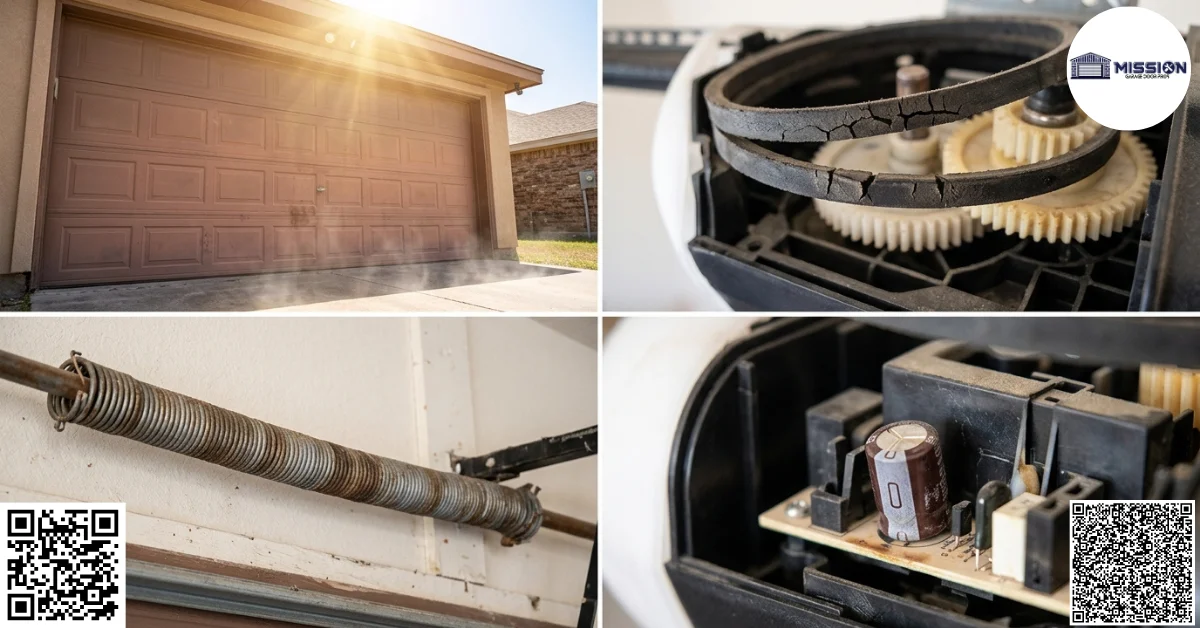

Imagine you are running late for work. You pack your lunch, grab your keys, hop into your car, and press the garage door opener button. You hear a loud click, a stressful straining sound, or maybe absolute silence. The door refuses to budge. You are trapped inside your own garage, and your morning schedule is officially ruined.
If this is happening to you right now, do not panic. In the Rio Grande Valley, our garage doors face unique challenges. From intense South Texas summer heat and high humidity to everyday wear and tear, your overhead door goes through a lot. A malfunctioning garage door is more than just an annoying inconvenience; it is a major home security hazard and a safety risk for your family.
At Mission Garage Door Pros, we have spent over 15 years servicing residential overhead doors right here in Mission, Texas. We know exactly why these heavy doors stop working and, more importantly, how to fix them safely. This comprehensive guide will walk you through the most common reasons your garage door won't open or close, help you troubleshoot basic issues, and explain when it is time to put down the wrench and call in the professionals.
Why Your Garage Door Won't Open: Common Culprits
When your garage door refuses to lift, the root cause usually boils down to a few critical mechanical or electrical failures. Because a standard garage door can weigh anywhere from 150 to over 300 pounds, the system relies on heavy-duty components to do the lifting for you. When one part fails, the entire system grinds to a halt.
1. Broken Torsion or Extension Springs
This is the single most common reason a garage door will not open. Many homeowners believe that the electric garage door opener does all the heavy lifting. In reality, the opener just acts as the brain; the garage door springs do the actual muscle work.
There are two main types of springs:
- Torsion Springs: Located on a metal shaft directly above the closed garage door.
- Extension Springs: Located on the sides of the upper tracks.
Garage door springs are rated for a specific number of "cycles" (one opening and one closing equals one cycle). Most standard residential springs are rated for 10,000 cycles, which generally lasts between 7 to 10 years. When a spring reaches the end of its lifespan, it will snap. If you were home when it happened, you likely heard a loud bang that sounded like a gunshot inside your garage.
Safety Warning: Never attempt to open a garage door manually if you have a broken spring. Without the spring's counterbalancing force, the door is incredibly heavy and can crash down, causing severe injury or damaging your automatic opener.
2. Snapped or Frayed Lifting Cables
Working directly alongside your springs are the heavy-duty aircraft cables. These cables attach to the bottom corners of your garage door and wind around drums at the top of the track system. When a spring snaps, or when the cables simply wear out from friction and humidity, they can fray or snap completely.
If a cable breaks on one side, the door will appear visibly crooked or misaligned in the tracks. Trying to operate a door with a broken cable can twist the entire track layout, bend the door panels, and ruin your roller assemblies.
3. The Opener Motor is Stripped or Unplugged
Sometimes, the issue is not mechanical, but electrical. If you press your wall button or remote control and hear absolutely no sound, check the simplest solution first: Is the opener plugged into the ceiling outlet?
It sounds silly, but vibrant vibrations from the door moving up and down can slowly loosen a plug over time. Additionally, Mission, TX is no stranger to sudden lightning storms and power surges. A power surge can easily trip your garage's GFCI outlet or fry the logic board inside your opener unit.
If you hear the motor humming or buzzing, but the door isn't moving, you might have a stripped drive gear. Inside most chain-driven and belt-driven openers is a small plastic gear that connects the motor to the drive chain. Over the years, these plastic teeth can wear down into white plastic dust, leaving the motor spinning freely without moving the chain.
Why Your Garage Door Won't Close: Safety and Track Issues
It can be even more stressful when your garage door opens up perfectly, but refuses to close. A garage door that stays wide open leaves your home, tools, vehicles, and family completely exposed to the elements and potential intruders.
1. Misaligned or Blocked Photo-Eye Sensors
If your garage door starts to go down, stops, and immediately reverses back up—often accompanied by the overhead opener light flashing ten times—your safety sensors are to blame.
Since 1993, federal law has required all automatic garage door openers to feature electronic safety sensors. These are the two small boxes located about six inches off the ground on either side of your garage door tracks. One sensor sends out an invisible infrared beam, and the other receives it. If anything breaks that beam, the door will refuse to close to prevent crushing an object, a pet, or a child.
Common sensor problems include:
- Dirt and Spiderwebs: Dust, grass clippings from lawn mowing, and cobwebs can block the small lenses.
- Physical Misalignment: If you accidentally bump a sensor with a garbage can or a bicycle, it can get knocked out of alignment. The small LED indicator lights on the sensors should be solid (usually one green, one amber). If one is blinking or dark, they are out of alignment.
- Direct Sunlight Blinding: In deep South Texas, the intense afternoon sun can literally blind the receiving photo-eye sensor, making it think there is an obstruction.
2. Bent or Obstructed Tracks
The metal tracks on either side of your door guide the rollers smoothly up and down. If a track gets bumped by a car bumper or hit by a heavy tool, it can bend inward. When the rollers hit that bent section, the increased resistance tells the opener motor that it has hit an obstacle, forcing it to reverse for safety.
Similarly, check for simple physical blockages. Tools, brooms, or small pebbles caught in the curved portion of the metal track can easily stop a door in its tracks.
3. Excessive Cable Tension or Spooling Issues
If your garage door cables come off their drums (often called a "slack cable" or "thrown cable"), the door will jam instantly. This usually happens if the door hits an object on the way down, causing the cables to lose tension and unwind incorrectly from the top metal spools. A door with thrown cables will often hang completely crookedly and cannot be closed manually without causing extensive damage.
+------------------------------------+------------------------------------+
| Symptom | Most Likely Cause |
+------------------------------------+------------------------------------+
| Loud bang, door won't lift at all | Broken Torsion or Extension Spring |
+------------------------------------+------------------------------------+
| Motor hums, but door stays down | Stripped Internal Drive Gear |
+------------------------------------+------------------------------------+
| Door starts down, reverses, lights | Misaligned or Dirty Safety Sensors |
| flash | |
+------------------------------------+------------------------------------+
| Door is visibly crooked and stuck | Broken or Thrown Lifting Cable |
+------------------------------------+------------------------------------+
Step-by-Step Troubleshooting for Homeowners
Before you make a service call, there are a handful of safe, straightforward troubleshooting steps you can perform yourself. Let's walk through how to safely inspect your door without putting yourself in harm's way.
Step 1: Check the Power Supply and Remote Batteries
If your door is unresponsive, verify that the outlet has power. Plug a small appliance or a lamp into the ceiling outlet to ensure it is live. If it isn't, check your home’s main breaker panel to see if a circuit breaker has tripped. Next, swap out the old batteries in your remote control transmitter and wireless keypad. Wall buttons use a direct wire connection, so if the wall button works but the remote doesn't, a dead battery or a lost remote program is your answer.
Step 2: Inspect and Clean the Safety Eyes
Grab a soft microfiber cloth and gently wipe away any dust, dirt, or moisture from the lenses of both safety sensors. If the indicator lights are blinking, gently loosen the wingnut holding the sensor bracket in place and adjust it until the light glows solid without flickering.
To combat the intense Texas sun blinding your sensors, you can build a small makeshift sunshield out of cardboard, or use an official DASMA-approved sun-shield extension to shade the lens from direct glare.
Step 3: Check the Lock Button on Your Wall Console
Many homeowners don't realize that their garage door wall console has a "Lock" or "Vacation" button. If this button is accidentally pressed and held down, it locks out all radio signals. This means your remote controls and keypad will stop working completely, but the wall button will still operate the door. If your remotes suddenly stop working out of nowhere, look at your wall panel—if a small light is blinking rapidly, hold down the Lock button for a few seconds to disable the lockout feature.
Step 4: Test the Manual Release Cord
If you need to get your car out immediately and your springs are completely intact, you can pull the red emergency release cord hanging from the opener carriage. This detaches the door from the automated rail mechanism, allowing you to lift it by hand.
Important Rule: Only pull the red emergency cord when the garage door is fully closed. If you pull it while the door is partially open, and the door happens to have a broken spring, the entire weight of the door will crash down instantly with crushing force.
The Danger of DIY: When to Call Mission Garage Door Pros
In the internet era, it is tempting to look up a video tutorial online and try to fix everything yourself to save a few dollars. While cleaning tracks or aligning sensors is completely safe, major overhead door repairs are fundamentally dangerous.
The True Power of Garage Door Springs
A standard garage door spring operates under an immense amount of tightly wound mechanical tension. To lift a heavy door, that steel spring stores enough kinetic energy to cause catastrophic injury or death if it snaps unexpectedly during installation. Professional technicians use specialized, hardened steel winding bars and specific safety protocols to handle these springs safely.
Using improvised tools like screwdrivers or pipe wrenches to wind a spring is a recipe for a trip to the emergency room. If your springs or cables require service, always leave it to the trained, insured experts at Mission Garage Door Pros.
Protecting Your Warranty and Home Investment
Modern automatic openers and high-quality insulated garage doors come with extensive manufacturer warranties. Attempting to disassemble your motor head, replace your own logic boards, or install aftermarket panels can immediately void these valuable warranties.
Furthermore, an improperly balanced garage door puts massive strain on your opener motor. Even if you manage to hook up a spring yourself, if it isn't tensioned perfectly to balance the door's weight, you will burn out your garage door opener motor within a few months, resulting in a much larger repair bill down the road.
Preventive Maintenance Tips for South Texas Homeowners
The best way to deal with a garage door repair emergency is to prevent it from happening in the first place. By dedicating just fifteen minutes every six months to basic maintenance, you can dramatically extend the lifespan of your springs, tracks, and opener.
1. Visual Inspections are Your Best Defense
Every few months, stand inside your closed garage and look closely at the moving parts. Look for:
- Fraying steel cables near the bottom brackets.
- Gaps in your torsion springs (a visible gap means it is broken).
- Loose bolts, sagging tracks, or worn-down rollers.
- Ripped or rotting bottom rubber weather seals.
2. Lubricate the Moving Parts Correctly
The heat and humidity in Mission, TX can quickly dry out factory grease, leading to loud grinding noises and premature wear.
- What to use: Use a high-quality synthetic silicone spray or a dedicated lithium-based garage door lubricant.
- What NOT to use: Never use WD-40 on your garage door. WD-40 is a degreaser and solvent, not a true lubricant. It will actually strip away the necessary grease, attract heavy dirt and valley dust, and gunk up your moving parts.
- Where to spray: Lightly coat your steel rollers, hinges, bearing plates, and the entire length of your springs. Do not lubricate the inside of the metal tracks; tracks should simply be wiped clean with a damp cloth to prevent the rollers from slipping.
3. Conduct a Balance Test
To see if your springs are doing their job correctly, test the balance of your door twice a year:
- Disconnect the opener by pulling the red emergency release cord while the door is closed.
- Gently lift the garage door manually halfway up and let go.
- The Result: A properly balanced door should hover in place, or move up or down very slowly. If the door slams shut or flies upward aggressively, the springs are out of balance and require professional adjustment.
Choosing the Right Replacement Door for Your Mission Home
If your garage door is severely damaged, rusting through, or constantly breaking down, continuous repairs might just be throwing good money after bad. It may be time to consider upgrading to a brand-new garage door replacement that adds serious curb appeal and insulation value to your home.
Insulated vs. Non-Insulated Doors
Given our blazing hot summers in Hidalgo County, an uninsulated garage door can turn your garage into a literal oven, radiating heat directly into your home's shared walls and driving up your monthly A/C electric bills.
Investing in an insulated door featuring polyurethane or polystyrene core insulation helps keep your garage significantly cooler. This is especially crucial if you use your garage as a home workshop, gym, or laundry room.
Wind-Load Rated Options
While Mission is located a bit inland from the Gulf Coast, we still experience strong tropical storms, heavy winds, and severe thunderstorms. A weak, unreinforced garage door is often the first structural element to fail during high-wind events. When a garage door blows inward, it alters the air pressure inside the home, which can cause the roof to lift off completely.
Choosing a door with certified wind-load reinforcement offers peace of mind and can even help lower your home insurance premiums.
Frequently Asked Questions (FAQs)
How much does it typically cost to replace a broken garage door spring in Mission, TX?
The cost to replace a broken garage door spring typically ranges between $150 to $350, depending entirely on the size, weight, and type of spring your specific door requires. This estimate generally covers the cost of high-cycle replacement springs, professional installation labor, and a complete safety balancing tune-up.
Can I operate my garage door opener if the door's tracks are slightly bent?
No, you should never run your automatic garage door opener if the metal tracks are bent or misaligned. Doing so can cause the rollers to bind up completely, strip your opener's internal gears, or burn out the motor entirely.
Why is my garage door making a loud scraping or grinding noise when it moves?
A loud scraping or grinding sound usually indicates that your moving parts are completely bone-dry and require immediate lubrication, or that your steel rollers are worn out and dragging along the track. In more severe cases, it can mean your lifting cables are rubbing against your header brackets due to improper system alignment.
How often should I schedule a professional garage door tune-up?
It is highly recommended to have a professional technician inspect and service your garage door system at least once a year. This annual maintenance ensures all safety mechanisms are fully functional and catches minor wear-and-tear issues before they turn into costly emergency breakdowns.
Final Thoughts
A malfunctioning garage door is a frustrating obstacle that disrupts your day and compromises your home's security. While minor issues like dirty safety sensors or dead remote batteries can be addressed with simple DIY troubleshooting, major mechanical issues—especially broken springs, damaged cables, and bent tracks—demand the attention of an experienced professional. Regular inspection and correct lubrication will keep your overhead door operating smoothly and safely for many years to come.
How Can Mission Garage Door Pros Help You?
When you need reliable, fast, and professional garage door repair in Mission, TX, look no further than Mission Garage Door Pros. We understand that a broken garage door is an urgent emergency, which is why our team of licensed technicians is always ready to provide prompt, same-day service across Mission and the surrounding Rio Grande Valley communities.
Whether you need an emergency spring replacement, a new opener installation, or a comprehensive safety tune-up, we bring 15 years of industry-leading experience right to your driveway. We pride ourselves on honest pricing, exceptional workmanship, and friendly local service. Don’t stay trapped out of your own garage—give us a call today to schedule your service appointment!
- Business Name: Mission Garage Door Pros
- Business Address: 2301 N Shary Rd, Mission, TX 78674
- Phone Number: (956) 997-9215